
Sword-billed hummingbird
The sword-billed hummingbird (Ensifera ensifera) is a unique South American species found in the Andes, famous as the only bird with a bill longer than its body. Measuring 13–14 cm excluding the bill, its beak can reach up to 12 cm, enabling it to feed on long, tubular flowers (Passiflora), while forcing it to perch with its head up and preen with its feet.
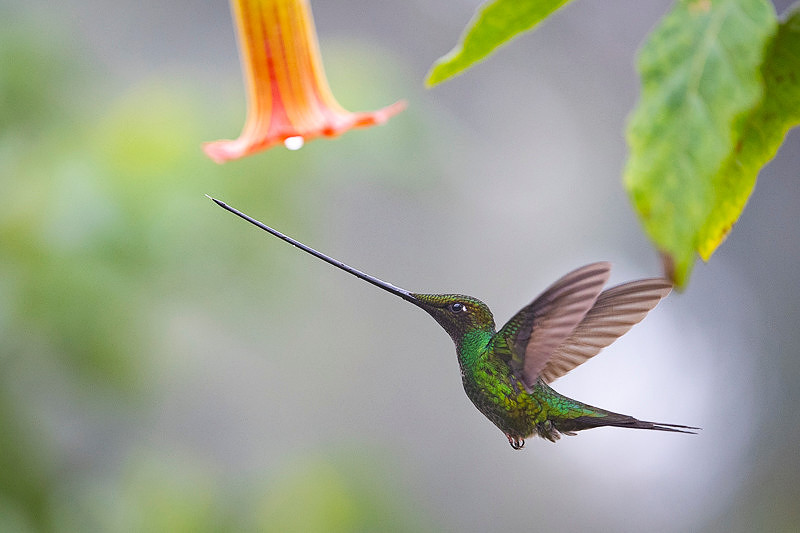

Distinctive Bill: The sword-billed hummingbird possesses the longest bill in proportion to its body of any bird, often exceeding the length of its body (head to tail).
Unique Feeding Adaptation: They evolved this long beak to access nectar from flowers with deep corollas, particularly species of the subgenus Tacsonia of the genus Passiflora.
Behavioral Adjustments: Because their beak is too long for standard grooming, these hummingbirds use their feet to scratch and preen. When perching, they hold their heads upright to maintain balance.
Location & Habitat: They are found in the Andes mountains from Venezuela through Colombia, Ecuador, Peru, and Bolivia, typically inhabiting cloud forests and humid, high-altitude shrubland at elevations of 1,700–3,500 m.
Appearance: They are primarily metallic green on the upperparts with bronze-green or golden-green underparts. Males generally have a more bronzy, iridescent head compared to females.
Physical Size: They are relatively large for a hummingbird, with a total length (including the bill) that can reach up to 20–25 cm.
Diet: While they are nectar specialists, they also consume small insects and spiders for protein.
Conservation Status: The IUCN lists the species as of "Least Concern" due to a large, stable distribution range, though they are vulnerable to climate change and habitat loss.
Non-migratory: They are generally non-migratory, but they may make local, altitudinal movements between seasons.